



Body Condition Score (BCS) is one of the most practical and cost-effective management tools available to livestock farmers, yet it remains underutilized in many livestock operations. This visual and tactile assessment method provides a rapid, non-invasive evaluation of an animal's reserves and nutritional status, offering insights that extend far beyond simple weight measurements. Unlike traditional weighing systems, which require equipment and can be labor-intensive, BCS allows producers to make informed management decisions in real-time during routine handling or visual inspection.
This article provides a comprehensive examination of BCS methodology, practical applications, and strategic implementation in modern cattle operations. Whether you manage beef cattle or dairy cows, understanding how to assess, monitor, and respond to body condition changes is essential for optimizing herd performance and economic returns. By mastering BCS, farmers gain a powerful tool for bridging the gap between nutrition, management, and animal performance—ultimately translating into improved animal welfare and sustainable profitability.
Prefer to listen to this article? Click the play button below and enjoy our podcast!
What Is Body Condition Score (BCS) in Cattle?
Body Condition Score is a standardized numerical assessment of an animal's body reserves based on visual appraisal and manual palpation of key anatomical points. In beef cattle, BCS is commonly assessed on a 1-to-9 scale, while dairy cattle often use a 1-to-5 scale. In both scales, 1 represents severe emaciation (meaning insufficient body reserves) and 9 (5) indicates extreme obesity. Most cattle operations maintain animals between scores of 4-7 (2,5-3,5), with optimal ranges varying by production stage and cattle type.
Evaluators assess specific anatomical regions: backbone, tail head, hip bone, pin bone, ribs, shoulder/brisket.
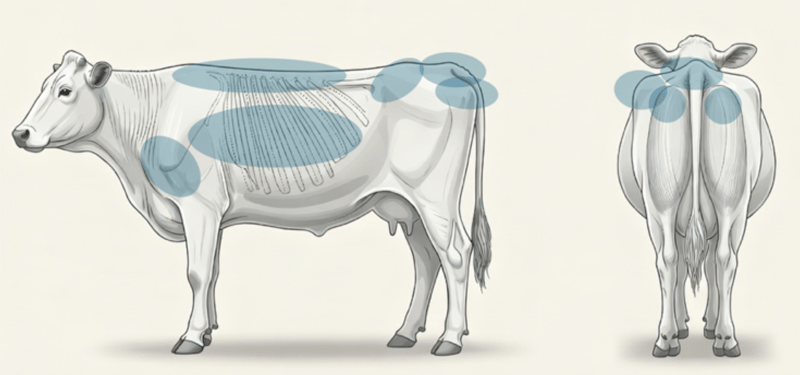
By feeling these bony structures beneath the skin and observing their visibility, trained evaluators can objectively estimate subcutaneous fat deposition and overall nutritional status. This methodology has been validated extensively in scientific literature and correlates strongly with actual body composition measurements obtained through other objective techniques such as ultrasound measurements and carcass evaluation.
Why is Body Condition Scoring Important in Cattle Management?
The significance of BCS in cattle management cannot be overstated. Maintaining optimal body condition directly impacts reproductive performance, milk production, immune competence, calf survival, and overall herd profitability. Research consistently demonstrates that cattle maintained at appropriate condition scores exhibit higher reproductive efficiency, reduced disease incidence, and improved longevity compared to their over- or under-conditioned animals.
BCS monitoring allows farmers to:
- Adjust feeding strategies
- Improve reproductive performance
- Reduce transition-period disorders
- Optimize pasture and feed efficiency
- Support welfare and longevity
- Improve economic performance
What Is the Ideal BCS for Cattle at Different Production Stages?
Ideal BCS values vary depending on species type, breed, production system, and physiological stage. In dairy cattle, most target values range between 2.5 and 3.5 on a 1-5 scale, while beef cattle typically target scores between 5 and 6 on a 1-9 scale, depending on the stage of production.
| Production Stage | Dairy Cattle BCS Target (1–5 scale) |
Beef Cattle BCS Target (1–9 scale) |
Main Objective |
| Calving | 3.0–3.25 | 5–6 | Optimize fertility, calving success and early lactation performance |
| Peak Lactation / Early Lactation | 2.5–3.0 | — | Limit excessive body reserve mobilization and metabolic stress |
| Breeding Season | 2.5–3.0 | 5–6 | Improve conception and pregnancy rates |
| Mid Lactation | 2.75–3.25 | 5 | Maintain production efficiency and body reserves |
| Dry-Off / Late Lactation | 3.0–3.5 | — | Prepare cows for transition and next lactation |
| Weaning | — | 4–5 | Maintain adequate cow recovery and reproductive efficiency |
| Replacement Heifers at Calving | 3.25–3.5 | 6 | Support growth, fertility and future productivity |
Maintaining animals within these optimal ranges helps minimize metabolic stress and reproductive delays.

How Should Farmers Monitor and Manage BCS in Cattle?
- Regular Assessment Schedule: Implement BCS evaluations at critical decision points: breeding season, pre-calving, early lactation, and mid-lactation. Monthly assessments during transition periods provide more detailed performance insights.
- Nutritional Adjustments: Body condition changes result from imbalances between energy intake and requirements. When scores decline below targets, increase energy-dense feedstuffs or improve forage quality. Conversely, over-conditioned cattle require reduced energy supplementation.
- Group Management: Animals with similar body condition scores often have similar nutritional needs. Implement separate feeding groups based on BCS to optimize resource allocation and prevent over or under feeding.
What Are the Most Common BCS Challenges in Cattle?
- Seasonal Fluctuations: Pasture-based systems experience natural seasonal condition changes. Plan supplementation during low-forage periods to maintain target scores, particularly in late gestation when energy demands increase.
- Individual Variation: Within-herd variation in body condition often reflects differences in milk production potential, metabolic efficiency, or parasitic burden. Identify chronically under-conditioned animals for potential culling decisions.
How Does BCS Affect Reproductive Performance in Cattle?
Reproductive efficiency is one of the areas most affected by body condition. Cows entering calving with inadequate reserves often struggle to meet the high energy demands of early lactation. This negative energy balance may delay ovarian activity and reduce conception success.
On the other hand, overconditioned cows can also face reproductive challenges, including increased inflammatory responses and calving complications. According to recent studies, monitoring BCS variation — rather than only isolated scores — is critical for predicting reproductive success and transition-cow health.
In beef systems, thin cows generally show reduced pregnancy rates and poorer calf performance due to insufficient milk production and energy reserves.
The Transition Period: A Critical Window
The transition period, typically defined as three weeks before to three weeks after calving, is one of the most metabolically demanding phases in dairy production. During this period, cows mobilize body reserves to support milk production, leading to BCS loss. Excessive mobilization, however, increases the risk of metabolic diseases. Excessive body fat mobilization is associated with inflammatory responses, impaired liver function and reduced production efficiency.
Effective transition management should therefore aim to:
- Avoid excessive BCS at calving
- Minimize rapid condition loss postpartum
- Support dry matter intake
- Ensure balanced energy and protein supply
Regular BCS evaluation provides a practical way to monitor whether nutritional strategies are effectively supporting cows during this critical phase.
Nutritional Management and Feed Efficiency
Body condition scoring is closely linked to nutritional management decisions:
- Thin animals may require increased energy density in their diet, improved forage quality, strategic supplementation and ensure reduced competition at feeding areas.
- Over conditioned animals on the other hand benefit from controlled-energy diets, improved exercise and reduction of feed intake.
BCS also helps optimize feed efficiency by aligning nutrient supply with actual animal requirements rather than relying only on generalized feeding plans.
In grazing systems, seasonal pasture fluctuations can strongly influence body reserves. Monitoring BCS throughout the year allows producers to anticipate nutritional shortages before productivity declines become visible. Also, it aids in pasture transitions and on rotational grazing management.
How Is BCS Related to Animal Welfare in Cattle?
BCS is increasingly recognized as an important animal welfare indicator. Extremely thin animals may indicate chronic undernutrition, parasitism, disease or poor management. Excessively fat animals may experience lameness problems, heat stress and metabolic dysfunction. Because body condition reflects long-term nutritional status, it is widely used in welfare audits and herd-health assessments.
Maintaining appropriate BCS contributes to a better immune function, improved mobility, lower disease incidence and higher resilience to environmental stressors.
As sustainability standards evolve, BCS monitoring is becoming increasingly relevant within broader livestock welfare and responsible-production frameworks.
Precision Livestock Farming and Automated BCS Technologies
Technological advances are changing BCS monitoring. Recent developments in computer vision, 3D imaging and artificial intelligence are opening the door for automated estimation of body condition using cameras and digital image analysis.
Studies such as Kojima et al. (2022) and Tang et al. (2026) demonstrate that 3D imaging systems can accurately predict BCS while reducing subjectivity between evaluators.
Automated systems may offer several advantages:
- Continuous monitoring
- Early detection of health or nutritional issues
- Reduced labor requirements
- Integration with precision feeding systems
- Improved herd-level decision making
As precision livestock farming expands, BCS is likely to become increasingly integrated into digital herd-management platforms.
Final considerations
Body Condition Score remains one of the most valuable practical tools in cattle production. By implementing consistent BCS protocols, farmers gain insight into herd nutritional status and animal welfare. The investment in training, monitoring, and responsive management decisions provides substantial returns through improved reproduction, enhanced production efficiency and strengthened herd longevity. In a time of margin compression and increasing production costs, BCS remains an invaluable, low-cost tool for sustainable profitability in cattle operations.

References
Daros, R. R., Eriksson, H. K., Weary, D. M., & von Keyserlingk, M. A. G. (2021). Body condition loss during the dry period: Associations with feeding behavior and transition cow performance. Journal of Dairy Science. https://doi.org/10.3168/jds.2020-19481
Dezetter, C., Bareille, N., Beaudeau, F., & Friggens, N. C. (2024). Association between body condition profiles, milk production and reproductive performance in dairy cows. Journal of Dairy Science. https://doi.org/10.3168/jds.2024-24766
Ghaffari, M. H., Sadri, H., Schuh, K., Dusel, G., Koch, C., Prehn, C., et al. (2023). Invited review: Assessment of body condition score and body fat reserves in transition dairy cows. Journal of Dairy Science, 106(2). https://doi.org/10.3168/jds.2022-22549
Kojima, T., Kato, Y., Ogawa, S., et al. (2022). Estimation of beef cow body condition score using three-dimensional body features. Livestock Science, 258. https://doi.org/10.1016/j.livsci.2021.104816
Mississippi State University Extension (2024). Body Condition Scoring Beef Cattle. https://extension.msstate.edu/sites/default/files/publications/P2508_web.pdf
Rearte, R., LeBlanc, S. J., Corva, S. G., de la Sota, R. L., & Giuliodori, M. J. (2023). Monitoring of body condition in dairy cows to assess health and reproductive status during the transition period. Animals, 13(19), 3076. 10.3390/ani13193114
Renquist, B. J., Oltjen, J. W., Sainz, R. D., & Calvert, C. C. (2006). Relationship between body condition score and production characteristics in beef cows. Livestock Science, 104(1–2), 147–155. https://doi.org/10.1016/j.livsci.2006.04.004
Roche, J. R., Friggens, N. C., Kay, J. K., Fisher, M. W., Stafford, K. J., & Berry, D. P. (2009). Invited review: Body condition score and its association with dairy cow productivity, health, and welfare. Journal of Dairy Science, 92(12), 5769–5801. 10.3168/jds.2009-2431
Sun, R., Overton, T. R., McArt, J. A. A., & Nydam, D. V. (2025). Effect of body condition score loss during the transition period on metabolic health and performance of dairy cows. 10.2478/jvetres-2025-0004
Tang, Z., Wang, J., Yu, H., et al. (2026). Can 3D point cloud data improve automated body condition score prediction in dairy cattle? https://doi.org/10.48550/arXiv.2601.22522
University of Missouri Extension (2021). Body Condition Scoring of Beef Cattle. https://extension.missouri.edu/publications/g2230
University of Wisconsin-Madison Division of Extension (2024). Body Condition Score in Dairy Cattle. https://dairy.extension.wisc.edu/articles/body-condition-score-in-dairy-cattle/
Wankhade, P. R., Manimaran, A., Kumaresan, A., et al. (2017). Metabolic and immunological changes in transition dairy cows: A review. Veterinary World, 10(11), 1367–1377. 10.14202/vetworld.2017.1367-1377

Leave your comments here