


Introduction
Dairy and beef production are inextricably linked. Although the main source of revenue in dairy herds is from milk sales, which is subject to the volatility of milk price, beef output from the sale of cull cows and surplus calves represents 10 to 20% of the gross income in most production systems. In most dairy herds, ≥60% of the calves born are destined for beef production, despite the fact that their genetics have been selected for dairy production. Indeed, nowadays, due to a combination of increasing dairy cow populations (especially in Europe in the post EU milk quota era) and, at least in some countries, a shrinking beef suckler cow population, ~65% of beef comes from the dairy herd.
The health and welfare of these ‘unwanted’ male dairy-breed calves, often of low economic value due to their poor beef traits, is a significant issue in the dairy industry worldwide and represents a major reputational risk to the industry (Schulze et al., 2023; Tuberquia-López et al., 2024).
Prefer to listen to this article? Click the play button below and enjoy our podcast!
How Can Reproductive Technologies Improve Beef-on-Dairy Production?
Reproductive technologies can improve beef-on-dairy production by helping farmers select genetically superior dairy females to produce replacement heifers while breeding other females to beef sires. Sex-sorted semen, artificial insemination, and embryo transfer can support these strategies and increase the beef value of surplus calves.
For that reason, “beef on dairy” is currently a hot topic (Berry, 2021). It is now possible to target only the most genetically elite females in the herd to generate replacements using sex-sorted semen, allowing new approaches to increase the value of the nonreplacement calves for beef production. One strategy to increase calf value is to mate dairy dams not required to generate replacement females (either surplus to requirements or genetically inferior) to beef sires to generate crossbred beef calves of superior beef merit. Interest in this strategy is increasing due to:
- A reduced need for dairy-on-dairy matings due to both improving fertility (driven by better genetics, nutrition, and management) coupled with the greater availability of sex-sorted semen from more genetically elite dairy sires.
- A desire to maintain cash flow through the sale of surplus progeny for meat production, thus providing protection against a volatile milk price.
- Availability of decision support tools, such as indexes of beef sires specifically selected for use on dairy females (Berry et al., 2019) as well as sire mating advice (Berry et al., 2025).
- Growing consumer interest in how food is produced and how it aligns with their social values.
This change in practice is reflected in the decreased use of dairy-on-dairy inseminations with conventional (unsorted) semen and a corresponding increase in the use of sex-sorted dairy semen and beef semen.

How does IVF and other ARTs Accelerate Cattle Genetic Improvement?
Animal breeders intentionally select the parents of the next generation based on their concept of the ‘ideal’ or ‘best’ animals in the current generation for the particular trait(s) of interest and the associated breeding objective (more milk, greater fertility, etc.). The speed at which genetic improvement can be achieved is controlled by:
- The selection intensity, a measure of how ‘choosy’ we are as breeders in selecting the ‘best’ animals.
- The selection accuracy, a measure of our confidence that the selected animals are indeed the best (impacted by the amount of information we have on the animal and its relatives).
- The genetic variation in the trait (the greater the variation, the greater the scope to select animals that are well above the population average).
- The generation interval, a measure of how quickly the superior genes of the selected parents in the current generation can be propagated into the next generation. Some of these parameters can be significantly impacted by assisted reproductive technologies (Figure 1).
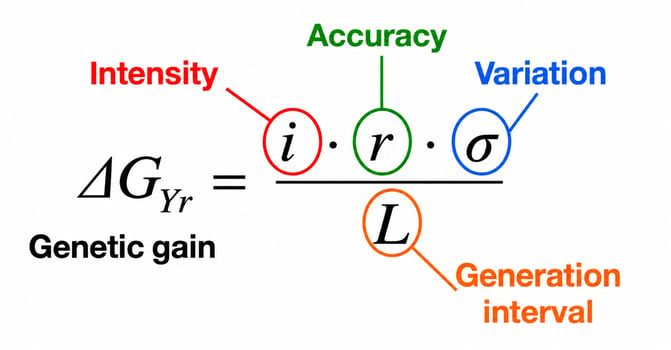
Figure 1. The Breeders’ Equation. The rate of genetic change is affected by the selection intensity, accuracy, variation in the trait and the generation interval. Artificial insemination has driven improvements in milk yield through intensive selection on the male side. Embryo transfer and the use of sex-sorted semen does for the female what AI did for the male by increasing selection intensity and improving accuracy by increasing the number of progeny from each elite female. The variation is a biological characteristic of the trait, while the generation interval, the bottleneck in livestock species breeding, can be hugely impacted through juvenile in vitro fertilization and embryo transfer (JIVET).
Role of assisted reproduction technologies
Advances in reproductive technologies provide a promising avenue for improving both the productivity and sustainability of dairy production systems (Crowe et al., 2021; Lonergan et al., 2025; Butler et al., 2026). Assisted reproductive technologies, including sex-sorted semen and embryo transfer, either using traditional multiple ovulation embryo transfer (MOET; ‘superovulation’) or in vitro embryo production (where embryos are made in the laboratory), offer considerable potential to accelerate genetic progress in dairy herds and improve the beef value of surplus calves born from females that are not required to produce replacement heifers. While use of beef semen is used to produce a crossbred calf to optimise the beef characteristics and potential market value, further benefits can potentially be achieved through the transfer of purebred beef embryos to cows not required to generate replacement heifers (Crowe et al., 2024).
Bovine embryo transfer has been a consistently growing market worldwide with the number of in vitro produced embryos transferred now far exceeding those produced by traditional superovulation (Viana 2025). In vitro embryo production offers significant advantages over traditional MOET including increased flexibility in sire usage, allowing multiple pregnancies from elite dam-sire combinations to be generated, the ability to produce more embryos per unit time per genetically elite female, the ability to use oocytes from prepubertal females (JIVET: Juvenile In Vitro Fertilisation and Embryo Transfer; Murphy et al., 2026), thereby significantly reducing the generation interval, and the more efficient use of rare or high-cost semen straws. Despite these benefits, significant challenges relating to pregnancy loss after embryo transfer, particularly after cryopreservation of in vitro produced embryos (Crowe et al., 2024, 2025; Sartori et al., 2025), and issues relating to peri- and postnatal health and development of the offspring remain to be resolved and hamper the more widespread application of the technology. Improvements in embryo culture media as well as in our understanding of the underlying physiological and molecular regulation of early embryo development and embryo-maternal communication leading to a successful pregnancy, as well as the application of newer and emerging embryo-based technologies, such as gene editing and, in the future, in vitro gametogenesis, will significantly contribute to improved reproductive efficiency and sustainability in agri-food production.
How Can Reproductive Technologies Contribute to More Sustainable Cattle Production?
More effective integration of dairy and beef breeding strategies offers substantial benefits including improved biological and economic efficiency of milk and beef production, reductions in waste and animal welfare concerns, and the delivery of higher-value beef products. Assisted reproductive technologies have an important role to play in by facilitating accelerated genetic gain, by increasing the economic value of the offspring, or both.
Take-home messages
- As global scrutiny on livestock farming increases, the dairy and beef industries are challenged to improve sustainability, animal welfare, and resource efficiency.
- A range of assisted reproduction technologies are now available in the toolbox available to farmers and breeders to accelerate genetic gain and improve beef merit of calves derived from dairy herds.
- Adoption of beef-on-dairy systems has increased rapidly in recent years, enabled by the growth in use of sex-sorted semen to generate replacement females and decision support tools to aid in the selection of beef sires for use on dairy dams.
- Embryo transfer has a role to play through the transfer of purebred beef embryos to nonreplacement dairy dams. Future research is needed to identify the underlying mechanisms of, and strategies to mitigate against, pregnancy loss after embryo transfer.
- Ultimately, the strategic alignment of dairy and beef breeding decisions represents a key opportunity to enhance the sustainability, resilience and societal value of modern livestock production systems.

References
AHDB. 2025. UK remains the global leader in the uptake of sexed dairy semen. https://ahdb.org.uk/news/uk-remains-the-global-leader-in-the-uptake-of-sexed-dairy-semen
Berry DP, Amer PR, Evans RD, Byrne T, Cromie AR, Hely F. A breeding index to rank beef bulls for use on dairy females to maximize profit. J Dairy Sci. 2019 Nov;102(11):10056-10072. doi: 10.3168/jds.2019-16912.
Berry DP. Invited review: Beef-on-dairy-The generation of crossbred beef dairy cattle. J Dairy Sci 2021;104(4):3789-3819. doi: 10.3168/jds.2020-19519.
Berry DP, McCarthy J. Sire mating advice framework for cattle to recommend which beef bull to mate to individual dairy females. J Dairy Sci 2025;108(3):2669-2682. doi: 10.3168/jds.2024-25600.
Butler ST, Crowe AD, Murphy EM, Evans RD, Lonergan P. 'Beef-on-dairy': harnessing assisted reproductive technologies to improve performance and sustainability in seasonal-calving systems. J Reprod Dev 2026; 72(3):158-164. doi: 10.1262/jrd.2025-135.
Crowe AD, Lonergan P, Butler ST. Invited review: Use of assisted reproduction techniques to accelerate genetic gain and increase value of beef production in dairy herds. J Dairy Sci 2021;104(12):12189-12206. doi: 10.3168/jds.2021-20281.
Crowe AD, Sánchez JM, Moore SG, McDonald M, Rodrigues R, Morales MF, Orsi de Freitas L, Randi F, Furlong J, Browne JA, Rabaglino MB, Lonergan P, Butler ST. Fertility in seasonal-calving pasture-based lactating dairy cows following timed artificial insemination or timed embryo transfer with fresh or frozen in vitro-produced embryos. J Dairy Sci 2024;107(3):1788-1804. doi: 10.3168/jds.2023-23520.
Crowe AD, Sánchez JM, Moore SG, McDonald M, McCabe MS, Randi F, Lonergan P, Butler ST. Incidence and timing of pregnancy loss following timed artificial insemination or timed embryo transfer with a fresh or frozen in vitro-produced embryo. J Dairy Sci 2025;108(1):1022-1038. doi: 10.3168/jds.2024-25139.
Lonergan P, Crowe A, Thompson L, Murphy E, Butler S. Enhancing integration of the dairy and beef sectors through application of assisted reproductive technologies: pregnancy outcomes following timed AI and timed ET in lactating dairy cows. Anim Reprod 2025; 22(3):e20250055. doi: 10.1590/1984-3143-AR2025-0055.
Murphy EM, Thompson L, McDonald M, Doyle RC, Silva TV, Bell L, Chaubal S, Creek M, Herlihy MM, Parra E, Torruella X, Huuskonen V, Furlong J, Randi F, Lonergan P, Butler ST. Investigation of laparoscopic ovum-pickup in juvenile heifers followed by in vitro embryo production and embryo transfer in dairy cattle. J Dairy Sci 2026; doi: 10.3168/jds.2026-28802.
Sartori R, Balistrieri M, Silva LOE, Consentini CEC, Melo LFE, Pontes GCS, Gaitkoski D. Pregnancy loss in cattle with emphasis on embryo transfer programs. Anim Reprod 2025; 22(3):e20250045. doi: 10.1590/1984-3143-AR2025-0045.
Schulze M, Kühl S, Busch G. We have Some Calves left! Socially Accepted Alternatives to the Current Handling of Male Calves from Dairy Production. Food Ethics 2023; 8:11. doi: 10.1007/s41055-023-00122-w.
Seidel GE Jr, DeJarnette JM. Applications and worldwide use of sexed semen in cattle. Anim. Reprod. Sci 2022; 246:106841. doi: 10.1016/j.anireprosci.2021.106841.
Tuberquia-López BC, Álvarez Hernández N, Correa Valencia N. A systematic review on management practices affecting welfare in male calves: A five domains model approach. Acta Veterinaria Eurasia 2024; doi:10.5152/actavet.2024.23097.
Viana JHM. 2024 Statistics of embryo production and transfer in domestic farm animals. International Embryo Technology Society Data Retrieval Committee, Embryo Technology Newsletter, v. 43, n.4, 2025. Available here: https://www.iets.org/Portals/0/Documents/Public/Publications/Newsletter/Vol43-Issue4/2024_Report_of_the_Data_Retrieval_Committee_Final.pdf?utm_source=CVEmail&utm_medium=CVEmail&utm_campaign=IETS_DRC_Report

Leave your comments here