


The dairy industry is a major global asset due to its economical and nutritional benefits. The European Union (EU) is one of the largest global producers of milk, having produced in 2024, around 156 million tonnes of cow’s raw milk, being Germany, France, Poland, Netherlands, Italy, and Ireland the highest producers [1].
European milk prices declined significantly during the first half of 2026 after reaching record levels in late 2024 and early 2025. Higher milk supply, favourable weather conditions and improving production led to lower farm-gate prices, although rising production costs continue to pressure dairy farm profitability.
However, the sector is increasingly exposed to structural pressures, including climate-related constraints, animal health challenges, regulatory frameworks, and input cost volatility. Understanding these dynamics is essential not only to anticipate market movements but also to support resilient and sustainable decision-making at farm level. This is particularly relevant as profitability margins tighten and production efficiency becomes a key determinant of competitiveness within the EU dairy sector.
Prefer to listen to this article? Click the play button below and enjoy our podcast!
How did European milk prices change between 2023 and the first half of 2026?
Throughout most of 2023, EU raw milk prices remained relatively stable before increasing in November, reaching 46.61 €/100 kg in December [2].
Throughout 2024, prices remained relatively stable until August, averaging 46.48 €/100 kg. From September to December, the prices increased to an average of 52.43 €/100 kg, and in the first half of 2025, the EU average milk price was at 53.3 €/100 kg, representing a 15% increase compared with the same period in 2024. This increase was driven by several factors:
- Constrained supply derived from disease, like the bluetongue virus (BTV) outbreak in some EU countries, weather shocks and stringent nitrate regulations in countries like Netherlands and Belgium;
- Seasonal uplift in demand from products like butter, cream and ice cream;
- Inflation that led to increases in input costs (ex.: feed, energy and labour) reducing profit margins;
- Policy paralysis derived from regulatory uncertainties, specially around EU’s climate goals, creating barriers to capital expansion and making long-term investments riskier [3; 4].
Table 1 – Raw milk prices in the main six producers in the EU and average in the EU from 2023 to 2026
| Sales prices (€/100 Kg) | Germany | Ireland | France | Italy | Netherlands | Poland | EU (without UK) |
|---|---|---|---|---|---|---|---|
| June 2023 | 41.97 | 39.43 | 45.63 | 51.60 | 43.25 | 43.12 | 44.27 |
| June 2024 | 45.85 | 44.48 | 45.98 | 49.70 | 47.75 | 45.52 | 46.13 |
| June 2025 | 53.86 | 51.76 | 49.01 | 58.13 | 56.75 | 53.12 | 52.89 |
| June 2026 | 40.67 | 39.72 | 42.73 | 45.43 | 41.50 | 42.99 | 42.34 |
| % Variation 2023-2026 | -3.10 | 0.74 | -6.36 | -11.96 | -4.05 | -0.31 | -4.36 |
Source: [2]
From October 2025, EU milk prices began to decline, and in the first quarter of 2026 the average raw milk price stood at 43.1 €/100 Kg, representing a 19% decrease compared with the same period in 2025 [2]. By June 2026, the EU average raw milk price had fallen to 42.34 €/100 Kg [2].
Among the main EU milk-producing countries — France, Germany, Ireland, Italy, the Netherlands and Poland — average raw milk prices fell by 20% in the first half of 2026 compared with 2025 [2].
Overall, prices declined across the EU, apart from Belgium, where milk prices increased from 38.17 to 41.5 €/100 Kg [2].
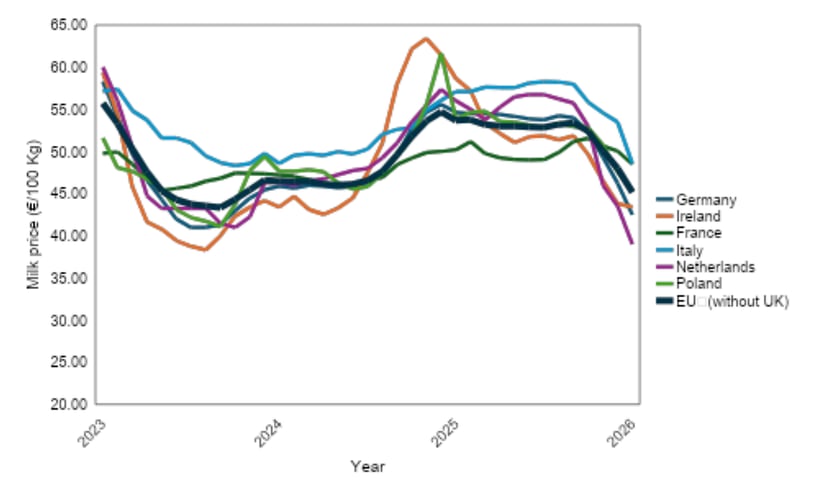 Graphic 1 – Evolution of raw milk prices in the EU between 2023 and 2026. [2]
What is the outlook for European milk prices in 2026?
European milk prices are expected to remain relatively stable during the remainder of 2026, although higher input costs and geopolitical uncertainty could place upward pressure on prices later in the year.
Average milk prices in the EU started to decline in October 2025 and remained stable since March 2026 [2; 5]. This decline and stabilization is explained by a 4.4% increase in milk collection during the first four months of the year, good weather conditions which improved feed availability and quality, favourable grassland conditions, delayed culling, and a rebound from postponed calving following animal disease outbreaks in key producing countries, which led to the market adjusting to the supply [5; 6].
For the remainder of 2026, the EU dairy herd is projected to decline by 0.9% in line with its long-term reduction driven by climate targets [5; 7]. Despite this, milk yields are expected to continue their upward trend, reaching 8 479 kg of milk per cow, with total EU milk production forecast to increase by 1.6% [5]. Ongoing geopolitical tensions in the Middle East are expected to put pressure on farm margins, potentially limiting the growth of the EU milk supply in the second half of 2026 [5].
Rising input costs—particularly fertilizers and energy, which increased by 4.2% and 5.6% respectively in the first quarter of 2026—have prompted farmers to delay fertilizers purchase. This delay may negatively impact future crop yields and reduce grain protein content [5; 8]. Consequently, dairy farm profitability will be constrained by rising feed costs, a major component of milk production. Ultimately, this scenario could exert upward pressure on farm-gate milk prices unless productivity gains offset the added expenses.
For the remainder of the year, prices are expected to remain stable or edge higher to help preserve farm margins and offset rising input costs. The outlook will largely depend on the effectiveness of measures such as the Fertiliser Action Plan, which aims to ease the pressure on fertiliser prices and the reduction in input costs [9].
Take Home Messages
The EU milk prices were highly volatile, with a peak in late 2024 followed by a significant decline into 2026 driven by increased supply. Despite lower market prices, input costs (like energy and fertilizers) have increased, putting pressure on farm margins.
To help alleviate the pressure on margins and support long-term resilience, farmers should focus on improving production efficiency, optimising feed and forage use, and reducing dependency on volatile external inputs. In a market shaped by uncertainty, these practical measures are not only environmentally sound, but also economically essential.
References
[1] European Comission, Milk and milk product statistics. (2025). Milk and milk product statistics - Statistics Explained - Eurostat (accessed 22nd of July 2026)
[2] European Commission, Milk Market Observatory. Milk - Agriculture and rural development - European Commission (accessed 16th of July 2026)
[3] Valeria Hamann, Gobal Dairy, Regulatory uncertainty and its impact on investment, EDairyNews (2025). Regulatory Uncertainty And Its Impact On Investment - EDairy News English (accessed 20th of July 2026)
[4] European Commission: Directorate-General for Agriculture and Rural Development, Short-term outlook for EU agricultural markets in 2025, Publications Office of the European Union, 2025.
[5] European Commission: Directorate-General for Agriculture and Rural Development, Short-term outlook for EU agricultural markets in 2026, Publications Office of the European Union, 2026.
[6] Sebastian Abbot, EU dairy short-term outlook – Spring 2026, AHDB (2026). EU dairy short-term outlook – Spring 2026 | AHDB
[7] Politico, The EU’s paradigm shift on cows, Politico (2026). The EU’s paradigm shift on cows – POLITICO (accessed 21st of July 2026).
[8] European Commission, Questions and answers on the Fertiliser Action Plan, Press Corner (2026). Questions and answers on the Fertiliser Action Plan (accessed 22nd of July 2026)
[9] European Commission, Commission presents plan to secure Europe's fertiliser supply and food security, Press Corner (2026). Commission presents plan to secure Europe's fertiliser supply and food security (accessed 22nd of July 2026)

Leave your comments here