


Introduction
Melatonin supplementation is not just about getting sheep ready for mating.
Although it made its fame as a reproductive controller, research over the last decade has shown that melatonin is quietly improving growth, immunity, milk, colostrum, and stress resilience in modern livestock production.
In other words: while we were all focused on ovaries and rams, melatonin was busy fixing half the farm in the background — silently, at night, like a good shepherd dog.
Prefer to listen to this article? Click the play button below and enjoy our podcast!
What is melatonin supplementation and why does it matter in livestock production?
Melatonin supplementation provides animals with a powerful physiological “night signal” that affects far more than reproduction.
This hormone acts simultaneously on metabolism, immunity, oxidative balance, and energy efficiency — all elements crucial for the animal's wellbeing, which ultimately are very important for sheep farmers.
In practical livestock production terms, melatonin supplementation helps animals to:
- Waste less energy on stress and inflammation
- Cope better with heat, high density, or metabolic pressure
- Invest nutrients where it matters (growth, milk, survival)
Think of melatonin as the farm manager who turns off unnecessary lights so the system stops burning electricity.
How does melatonin supplementation affect fetal development and neonatal adaptation?
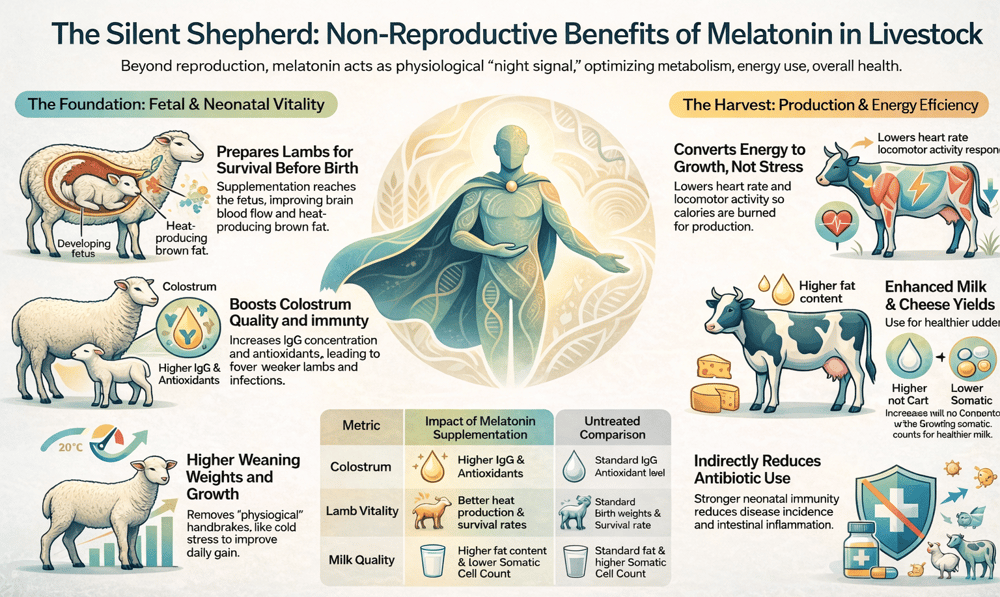
Melatonin supplementation during pregnancy prepares lambs before they are even born.
The fetus does not produce melatonin, so it relies entirely on the dam — meaning maternal supplementation goes straight to the next generation.
Studies in sheep show that melatonin acts directly on fetal organs responsible for survival after birth:
- Brain blood vessels → avoids excessive constriction
- Brown adipose tissue (BAT) → better heat production at birth
- Adrenal gland → controlled cortisol exposure
In farm language: lambs are born warmer, calmer, and better prepared — not panicking on day one like interns on their first shift.
Can melatonin supplementation improve lamb growth and survival?
Yes — and this is where these benefits become especially visible on farm. Across breeds and production systems, lambs born from melatonin-treated ewes consistently show better health and performance.
Reported benefits include:
- Higher weaning weights
- Higher average daily gain
- Better survival rates, especially in males and singletons
The key point is that melatonin supplementation does not “push” growth artificially. It simply removes physiological handbrakes — cold stress, inflammation, inefficient energy use — so lambs grow the way they were supposed to all along.
Why does melatonin supplementation improve colostrum quality?
Melatonin supplementation increases colostrum IgG concentration and antioxidant capacity. This has been demonstrated repeatedly in sheep and goats under real farm conditions.
What does that mean on the ground?
- Lambs absorb more antibodies
- Early immune protection improves
- Less diarrhoea, stronger lambs, and smoother starts during the first days of life
- There is even evidence that lambs born from melatonin-treated ewes shed fewer coccidia oocysts, meaning less infection pressure for the whole flock.
Not bad for a molecule most people associate with insomnia!
Does melatonin supplementation affect milk yield and milk quality?
Yes, especially when supplementation is applied before lambing or kidding. Melatonin receptors are present in the mammary gland, so this is not accidental biology — the udder is listening.
Observed effects include:
- Increased milk yield in early lactation
- Higher milk fat concentration
- Lower somatic cell count (SCC)
From a flock management perspective:
- More fat = better cheese yield
- Lower SCC = fewer penalties
- Healthier udder = fewer antibiotics
Melatonin doesn’t milk the ewe for you — but it definitely makes her job easier.
How does melatonin supplementation influence stress and energy efficiency?
Melatonin supplementation reduces unnecessary energy expenditure. Physiological monitoring using biologgers shows treated lambs have:
- Lower heart rate
- Lower body temperature
- Reduced locomotor activity
This does not mean lambs are lazy!
It means they are efficient — burning calories for growth instead of running around like they’ve had too much espresso.
In feedlot and fattening systems, this can translate into better feed conversion, particularly in females.
Take-home messages
- Melatonin supplementation is no longer just a reproductive trick — it is a multifunctional management tool in livestock production.
- By improving fetal development, colostrum quality, milk composition, and metabolic efficiency, melatonin helps animals perform better without forcing physiology.
- In a world with less antibiotics, more heat stress, and tighter margins, melatonin works quietly at night — and shows its results during the day.
References
-
Abecia, J. A., Espés, E., Jiménez, S., & Canto, F. (2025). Effects of exogenous melatonin in pregnant ewes on offspring performance, live weight and daily growth rate of lambs for fattening, as well as milk quality. Animal Production Science, 65, AN24116. https://doi.org/10.1071/AN24116
-
Abecia, J. A., Luis, S., & Canto, F. (2021). Implanting melatonin at lambing enhances lamb growth and maintains high fat content in milk. Veterinary Research Communications, 45, 181–188. https://doi.org/10.1007/s11259-021-09799-y
-
Abecia, J. A., Manenti, I., Viola, I., Toschi, P., Palacios, C., Canto, F., & Miretti, S. (2025). Triaxial accelerometers and subcutaneous biologgers as tools to record diurnal and nocturnal changes in locomotor activity, body temperature, heart rate, and heart rate variability in melatonin-treated lambs (Ovis aries). Comparative Biochemistry and Physiology Part A, 305, 111849. https://doi.org/10.1016/j.cbpa.2025.111849
-
Bouroutzika, E., et al. (2021). Association of melatonin administration in pregnant ewes with growth, redox status and immunity of their offspring. Animals, 11, 3161. https://doi.org/10.3390/ani11113161
-
Bouroutzika, E., et al. (2023). Melatonin administration to pregnant ewes for coccidiosis control in their offspring. Animals, 13, 2381. https://doi.org/10.3390/ani13142381
-
Canto, F., Fantova, E., Riaguas, L., & Abecia, J. A. (2024). Melatonin-implanted pregnant ewes produce lambs that have higher average daily growth rates and live weights at weaning. Sheep & Goat Research Journal, 39, 1–6.
-
Canto, F., González, E., & Abecia, J. A. (2022). Effects of implanting exogenous melatonin 40 days before lambing on milk and colostrum quality. Animals, 12, 1257. https://doi.org/10.3390/ani12101257
-
Canto, F., Peña-Delgado, V., Noya, A., Manenti, I., & Abecia, J. A. (2024). Using melatonin implants in late pregnancy increases milk production and improves milk quality in dairy goats. Canadian Journal of Animal Science, 104, 1–9. https://doi.org/10.1139/cjas-2023-0123
-
Canto, F., & Abecia, J. A. (2024). Effects of melatonin implants in late gestation and at lambing on colostrum and milk quality of ewes, birth temperature and growth performance of their lambs. Small Ruminant Research, 232, 107210. https://doi.org/10.1016/j.smallrumres.2024.107210
-
Canto, F., & Abecia, J. A. (2024). Exogenous melatonin: effects on lactation and colostrogenesis in small ruminant livestock. Large Animal Review, 30, 273–280.
-
Torres-Farfan, C., et al. (2008). Evidence of a role for melatonin in fetal sheep physiology. Journal of Physiology, 586, 4017–4027. https://doi.org/10.1113/jphysiol.2008.154351
-
Viola, I., et al. (2024). Exogenous melatonin ameliorates embryo–maternal cross-talk in early pregnancy in sheep. Reproduction, 168, e240172. https://doi.org/10.1530/REP-24-0172
-
Viola, I., Canto, F., & Abecia, J. A. (2023). Effects of melatonin implants on locomotor activity, body temperature, and growth of lambs fed a concentrate-based diet. Journal of Veterinary Behavior, 68, 24–31. https://doi.org/10.1016/j.jveb.2023.08.004
Leave your comments here