


Introduction
Global dairy production is increasingly driven by large-scale farms capable of producing hundreds of thousands of tonnes of raw milk annually. This article ranks the world’s top 10 largest dairy farms based on annual milk output, highlighting how scale, technology, and productivity shape modern dairy production.
Prefer to listen to this article? Click the play button below and enjoy our podcast!
Why is scale becoming the dominant factor in global dairy production?
Global dairy production is no longer defined by herd expansion alone. Instead, scale, productivity per cow, capital intensity and technology adoption are now the primary drivers of competitiveness.
According to the OECD–FAO Agricultural Outlook, global milk production is projected to grow at 1.5–2% annually through 2033–2034, with the majority of growth coming from higher yields, improved herd management, and technological innovation, rather than increases in animal numbers.

How were the world’s largest dairy farms ranked?
Ranking dairy farms at a global level is complex. Data availability varies widely, reporting standards differ by country, and many operations do not publicly disclose detailed production figures. As a result, estimates and conservative assumptions are sometimes required.
This article aims to present an attempt of a global Top-10 ranking of dairy farms and farm groups, based strictly on annual raw milk production per farm/farm groups. The scope is deliberately narrow to ensure comparability:
- Only farms or farm groups that own and directly manage dairy herds are included
- Dairy cooperatives, processors, and farmer networks are excluded
- The goal is structural consistency at the farm level, not market share or processing capacity
Where is large-scale dairy production geographically concentrated?
Mega-scale dairy farms are primarily concentrated in China, Saudi Arabia, Russia, the United States, and Southeast Asia. These regions combine access to capital, land, and regulatory frameworks that allow this model of scale.
|
Rank |
Farm / Farm Group |
Country |
Raw milk production (t/year) |
|
1 |
Mudanjiang Mega Dairy Farm |
China |
≈2,000,000 |
|
2 |
Almarai |
Saudi Arabia |
≈1,470,000 |
|
3 |
Modern Dairy |
China |
≈1,280,000 |
|
4 |
EkoNiva |
Russia |
≈1,200,000 |
|
5 |
Riverview LLP |
USA |
≈800,000–1,000,000 |
|
6 |
Rockview Family Farms |
USA |
≈1,000,000 |
|
7 |
Huishan Dairy |
China |
≈800,000 |
|
8 |
Al Safi Dairy Farm |
Saudi Arabia |
≈550,000 |
|
9 |
Greenfields Dairy Farm |
Indonesia |
≈400,000–450,000 |
|
10 |
Fair Oaks Farms |
USA |
≈350,000–400,000 |
Which farms lead global dairy production by scale and output?
1. Mudanjiang Mega Dairy Farm (China)
At the top of the ranking stands Mudanjiang Mega Dairy Farm, producing an estimated 2 million tonnes of raw milk annually. With a herd exceeding 135,000 dairy cows, it currently represents the most concentrated industrial dairy operation. Milk yields approaching 15,000 kg per cow per year reflect intensive genetic selection, precision nutrition, and fully controlled housing systems.
2. Almarai (Saudi Arabia)
Saudi Arabia features prominently, led by Almarai, whose dairy farms collectively produce close to 1.5 million tonnes of milk per year under desert conditions. This output is enabled by heavy investment in cooling infrastructure, imported feed, and vertical integration. While highly resource-intensive, these systems demonstrate that climatic constraints can be overcome through capital and technology, achieving productivity levels comparable to temperate-zone mega-farms.
3. Modern Dairy (China)
Modern Dairy ranks among the world’s largest dairy producers, with an estimated annual production of around 1.28 million tonnes of raw milk. The company operates multiple very large farms under centralized ownership, allowing them to capture economies of scale while spreading geographic and climatic risk.
4. EkoNiva (Russia)
EkoNiva is Russia’s largest dairy farm group, with annual milk production estimated at approximately 1.2 million tonnes. The group’s size and presence across multiple farming sites help balance production conditions across regions, limiting the impact of weather or regional disruptions on overall milk output.
5. Riverview LLP (United States)
In the United States, Riverview LLP has emerged as one of the largest dairy operators, with annual milk production estimated between 800,000 and 1 million tonnes. Operating across multiple states, the company relies heavily on automation, genetic progress, feed efficiency, and data-driven management to remain competitive in a mature market characterized by rising labor, regulatory, and environmental costs.
6. Rockview Family Farms (United States)
Rockview Family Farms ranks among the world’s largest dairy operations, with annual milk production close to 1 million tonnes. It is recognized as the largest documented family-owned dairy farm group, highlighting the scale that can be reached under single-family ownership.
7. Huishan Dairy (China)
Huishan Dairy represents a centrally managed, multi-farm group in China, with total production of approximately 800,000 tonnes per year. Its model emphasizes geographic dispersion, standardized management, and integration with domestic processing and retail markets.
8. Al Safi Dairy Farm (Saudi Arabia)
Al Safi Dairy Farm, is one of the world’s largest single-site, fully integrated dairy operations, with annual milk production of around 550,000 tonnes. Located in Saudi Arabia, its performance is driven by extreme capital intensity and advanced cooling systems, enabling consistently high productivity despite harsh climatic conditions.
9. Greenfields Dairy Farm (Indonesia)
Greenfields Dairy Farm generates an estimated 400,000 to 450,000 tonnes of milk per year, making it one of Southeast Asia’s largest dairy operations.
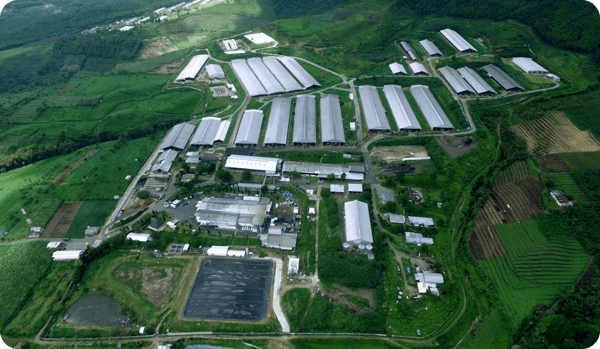 Source: Greenfields
10. Fair Oaks Farms (United States)
Fair Oaks Farms, the largest documented single-site dairy farm in the U.S., rounds out the top 10 with 350,000 to 400,000 tonnes of annual milk production.
Which technologies drive efficiency in large-scale dairy production?
Across all Top-10 farms, innovation is the common denominator. High-output dairy systems consistently deploy:
- Precision feeding and ration optimization
- Digital herd monitoring and health analytics
- Advanced reproductive and genetic programs
- Automation and standardized operating protocols
These technologies underpin the OECD–FAO projection that future milk supply growth will be driven primarily by productivity gains per animal, not by expanding herd sizes.
Why are European dairy farms absent from the global top 10 ranking?
One outcome of this ranking is the absence of European Union dairy farms from the global Top-10. This is not due to missing data, but to structural differences in production models.
European dairy farming is dominated by family-owned farms, operating under strict environmental, animal-welfare, and land-use regulations. Scale is achieved primarily through cooperative aggregation, rather than through ultra-large, centrally owned farms. As a result, even Europe’s largest individual farms fall well below the production thresholds required for inclusion in a global Top-10 ranking based on raw milk output per farm. Nonetheless, the EU's dairy sector is highly efficient and will be addressed in future articles.
Key Takeaways
- The world’s largest dairy farms highlight a sector increasingly driven by scale, capital, and technology.
- Productivity gains—not herd expansion—will define future milk supply growth.
- Cooperative-based models are dominant in Europe and India, while mega-farms dominate in China and Saudi Arabia.
- Understanding these structural differences is essential for informed discussions on sustainability, competitiveness, and global food security.

References
OECD & FAO. (2025). OECD-FAO Agricultural Outlook 2025–2034: Dairy and dairy products chapter. OECD Publishing. https://www.oecd.org/en/publications/2025/07/oecd-fao-agricultural-outlook-2025-2034_3eb15914/full-report/dairy-and-dairy-products_1dd2e5a6.html
FAO. (2024). Dairy Market Review 2024: Overview of global dairy market developments in 2023. Food and Agriculture Organization of the United Nations. https://www.fao.org/markets-and-trade/publications/dairy-archive/en
Hemme, T., & Otte, J. (Eds.). (2022). IFCN Dairy Report 2022 (extract). International Farm Comparison Network. Retrieved from https://ifcndairy.org/wp-content/uploads/2022/11/Dairy_Report_2022_extract.pdf
International Farm Comparison Network. (2023). IFCN Dairy Report 2023 farm comparison (extract). IFCN. Retrieved from https://ifcndairy.org/wp-content/uploads/2023/10/Dairy-Report-23-Marketing-extract.pdf
European Parliament Research Service. (2018). EU livestock farming: Structure and trends.
https://www.europarl.europa.eu/thinktank/en/document/EPRS_BRI(2018)630345
Santos, A.S. (2025). World's largest integrated dairy farm: a look at innovation and scale. CEVA Ruminants Blog. Published May 2025. https://ruminants.ceva.pro/dairy-farming
Sousa, A.V. (2023). Top 10 dairy farms in the world. In CEVA Ruminants Blog. Published August 2023. https://ruminants.ceva.pro/dairy-production
Leave your comments here