


Introduction
Modern cattle production operates at the intersection of biology, economics, and precision management. Faced with rising labor costs, volatile feed prices, growing societal and regulatory expectations around animal welfare and sustainability, and the need to remain economically competitive, producers are turning to Precision Livestock Farming (PLF) as a strategic solution. While farms now collect unprecedented amounts of data, the real challenge lies in converting these signals into timely, reliable actions.
Farm data analytics addresses this by integrating data from milking systems, activity sensors, and feeding platforms into actionable insights, revealing patterns invisible in large, dynamic herds. This article reviews the main digital monitoring tools available and examines how data pipelines and analytics methodologies translate raw information into practical decision support, ensuring that modern cattle operations remain both competitive and sustainable.
Prefer to listen to this article? Click the play button below and enjoy our podcast!
What is data analytics in herd management?
Data analytics in herd management refers to the systematic collection, analysis, and interpretation of animal- and farm-level data to support decision-making. This data may include reproductive records, weight measurements, feed intake, health events, and behavioural indicators. Rather than relying only on periodic visual assessments or manual records, data analytics enables continuous and objective monitoring of herd performance.
The shift from traditional observation-based management to data-driven systems represents a major transformation in livestock operations. While “traditional” management remains essential, analytics adds a layer of precision by revealing patterns and trends that are difficult to detect with daily routine. Subtle changes in growth rate, reproductive behaviour, or feed efficiency can be identified early, before they escalate into costly issues.
Accurate and continuous data collection is the foundation of effective analytics. Poor-quality or inconsistent data limits the value of any system, whereas reliable data allows producers to build meaningful benchmarks and track progress over time. This approach is closely linked to precision livestock farming (PLF), where technology and data are used to manage animals according to their individual needs rather than applying uniform strategies across the entire herd.
How does data analytics improve overall herd performance?
One of the main advantages of data analytics is its ability to identify trends in herd performance. By analysing historical and real-time data, producers can monitor weight gain, health status, fertility, and productivity across different groups of animals. This makes it easier to distinguish between normal variation and emerging performance issues.
Real-time or near-real-time monitoring plays a key role in early detection. Deviations from expected growth curves, changes in activity levels, or declining reproductive indicators can be flagged quickly, allowing for timely interventions. Early action often reduces treatment costs, minimizes production losses, and improves animal welfare.
Data analytics also allows and facilitates comparisons between individual animals and herd-level data. Farmers can assess how each animal performs relative to the herd average, historical performance, or predefined targets. These comparisons support more objective decisions around culling, breeding selection, feeding strategies and health management. Over time, this leads to a more uniform, productive, and resilient herd. Cattle farms generate high volumes of daily data. The value lies in turning that information into insight. Analytic platforms aggregate and interpret these inputs to highlight trends in milk production, growth curves, cow health, and reproductive outcomes.
By benchmarking individual animals against herd averages or historical performance, farmers can identify high performers, manage underperformers, and refine grouping strategies. This supports better decisions around:
- Selective culling based on lifetime productivity
- Breeding choices using performance and fertility records
- Group feeding adjustments to maintain consistent production output
- Early health interventions that reduce treatment costs and production loss
Ultimately, analytics improves herd uniformity and longevity—two key drivers of profitability.
What digital monitoring tools are used in modern cattle systems?
Digital monitoring tools in cattle operations can be grouped according to the type of signal measured and the point of deployment.
Wearable sensors, such as collars, leg bands, or ear tags, are among the most widely adopted technologies. They typically measure activity, rest patterns, rumination proxies, and sometimes body temperature. These systems enable individual-level monitoring and are commonly used for heat detection, health alerts, and behavior analysis. However, their performance depends on correct calibration, stable attachment, and battery life.
Indigestible sensors, often in the form of rumen boluses, provide internal measurements such as rumen temperature and activity proxies. These are particularly useful for early detection of health disorders but involve higher costs and limited recoverability.
Vision-based systems, including RGB and depth cameras, are increasingly used to assess body condition score, lameness, feeding behavior, and animal presence. These systems offer non-invasive monitoring at group level but require robust algorithms to handle occlusion, lighting variability, and barn-specific layouts.
Milking system sensors, especially in automated milking systems (AMS), generate high-frequency data on milk yield, flow, conductivity, and milking behavior. When integrated with animal and feeding data, they are powerful inputs for health and production monitoring.
Environmental and infrastructure sensors measure barn environmental conditions (such as temperature and humidity), water intake, or pasture boundaries (e.g., virtual fencing), providing contextual information essential for interpreting animal-level data.
How is raw sensor data transformed into decision-ready farm data?
Transforming sensor outputs into decision-ready information requires a structured data pipeline. First, data acquisition must balance sampling frequency with energy consumption and relevance. Many systems perform on-device preprocessing, transmitting summarized features rather than raw signals.
Second, connectivity technologies (e.g. cellular, Wi-Fi) must be chosen according to farm topology and reliability requirements. Buffering and fault tolerance are essential in remote or pasture-based systems.
Third, data integration is critical. Sensor data must be linked to consistent animal identifiers and combined with contextual information such as parity, days in milk, diet, and treatment history. Lack of interoperability remains a major bottleneck.
Fourth, data quality management is required to address missing values, sensor drift, hardware changes, and seasonal effects. Without transparent quality control, analytics outputs risk losing farmer trust.
Finally, data storage and governance determine long-term usability, ownership, and compliance, particularly when multiple vendors and advisory services are involved.
How does the analytics layer transform indicators into predictions?
Analytics in cattle monitoring systems can be viewed through Gartner’s Analytics Ascendancy Model (often referred to as the stages of data analysis) illustrating how systems progress from reporting to action-oriented intelligence:
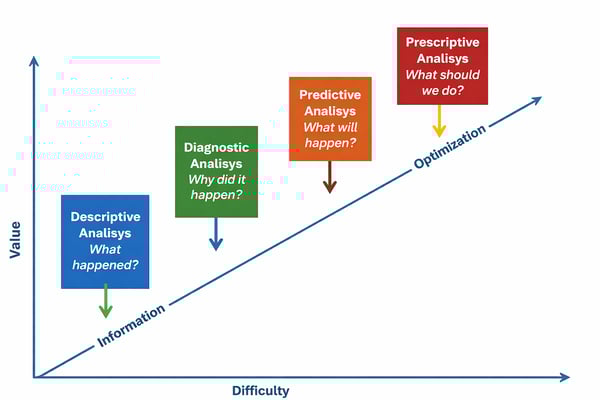
Adapted from Gartner Analytics Ascendancy Model
- Descriptive level (what happened?): dashboards summarize indicators such as activity time budgets, rumination minutes, or milk yield trends. These provide situational awareness but limited decision guidance.
- Diagnostic analytics (why did it happen?): combine multiple indicators and contextual rules to explain deviations, for example linking reduced rumination and activity with stage of lactation or recent diet changes.
- Predictive analytics (what will happen?): use statistical models or machine learning to anticipate events such as oestrus, mastitis, lameness, or calving. Model robustness, validation across farms, and transparency are essential to avoid overconfidence.
- At the highest level, prescriptive analytics (how to make it happen?): aim to recommend concrete actions (e.g., check a specific cow, adjust grouping, initiate treatment), often with an associated confidence score. This stage represents the closest link between analytics and on-farm decisions.
How can producers track fertility and reproductive efficiency using data?
Reproductive performance remains one of the most critical determinants of livestock farm success. Missed heats, extended days open, and long calving intervals directly impact production and replacement costs. Data analytics significantly improves reproductive management by providing objective, continuous monitoring.
Activity and behavioural sensors help detect oestrus more accurately than visual observation alone, especially in high-producing cows that show weaker heat expression. Automated alerts allow timely insemination, improving conception rates and reducing labour demands. All this info combined in an automated breeding calendar provides higher efficiency.
How does data help monitor weight gain and growth performance?
Weight gain and growth performance are central indicators of herd efficiency, particularly in beef production and growing dairy replacements. Data analytics supports accurate measurement of average daily gain (ADG), reducing reliance on infrequent or subjective assessments.
By analysing weight data over time, farmers can forecast growth curves and estimate when animals will reach market weight or breeding targets. This improves planning for feed allocation, marketing decisions, and facility use.
Analytics is especially valuable for identifying underperforming animals early. Animals that deviate from expected growth trajectories can be flagged for further evaluation, allowing producers to investigate potential health, nutritional, or management issues. Early identification prevents prolonged inefficiency and supports more targeted interventions.
Aligning nutrition programs with growth targets becomes more precise when decisions are guided by data rather than assumptions. Feed rations can be adjusted based on measured performance, improving consistency and reducing wasted inputs.
How does data help monitor milk production and cow performance?
Unlike beef systems focused on weight gain, dairy operations prioritize sustained, efficient milk production throughout lactation. Data analytics can provide detailed insight into how cows perform across their production cycle.
Most milking systems continuously record:
- Daily milk yield
- Fat and protein percentages, somatic cell count
- Milking frequency and duration (in AMS systems)
Analysing this data helps farmers and practitioners forecast lactation curves, evaluate persistency, and detect abnormal drops in production before clinical signs appear. At the same time, integrating milk data with health, reproduction, and nutrition records allows farms to understand why performance changes occur.
This level of visibility supports more precise feeding strategies, improved transition cow management, and better lifetime productivity.
Why is feed efficiency essential in data-driven herd management?
Feed represents the largest variable cost on farms, often accounting for more than half of total production expenses. Data analytics allows farmers to evaluate how efficiently cows convert feed into milk or weight using metrics such as feed conversion ratio (kg product per kg dry matter intake) or residual feed intake (RFI). By linking feeding data with milk output and body condition scoring, farmers can identify animals or group of animals that produce more milk with fewer inputs. These insights support:
- Optimized ration formulation based on real performance
- Selection of genetically efficient animals
- Reduced feed waste and improved nutrient utilization
- Lower environmental footprint per kg of animal product produced
Improving feed efficiency not only enhances profitability but also contributes to sustainability goals by reducing emissions intensity and resource use.
Take home messages
Farm data analytics is transforming how producers manage fertility, production, and feed efficiency in increasingly complex operations. By converting routine operational data into meaningful insights, analytics enables earlier interventions, more precise decision-making, and improved herd consistency. Far from replacing the experience of farmers and herd managers, data-driven tools amplify it by providing the aid needed to manage cows individually while optimizing performance at the herd level.
As cattle farming continues to balance productivity with sustainability, leveraging these tools is rapidly becoming an essential component for aligning performance with the higher welfare and sustainability standards of future cattle systems.
Ultimately, the progress of integrated production will depend on data integration and decision-centric design, ensuring that PLF technologies deliver their full value—not by simply collecting more data, but by enabling transparent, auditable, and economically viable decisions that are ready for the challenges of tomorrow.
References
Bernabucci, G., Basiricò, L., Morera, P., & Lacetera, N. (2025). Precision livestock farming: Applications of sensors and data analytics in livestock systems. Italian Journal of Animal Science, 24(1), 1–15.
https://doi.org/10.1080/1828051X.2025.2480821
Cominotte, A., Fernandes, A. F. A., Dorea, J. R. R., Rosa, G. J. M., Ladeira, M. M., van Cleef, E. H. C. B., & Neto, O. M. (2020). Automated computer vision system to predict body weight and average daily gain in beef cattle. Livestock Science, 232, 103904.
https://doi.org/10.1016/j.livsci.2019.103904
De Vries, A. (2006). Economic value of pregnancy in dairy cattle. Journal of Dairy Science, 89(10), 3876–3885.
https://doi.org/10.3168/jds.S0022-0302(06)72430-4
Dohmen, R., Eerdekens, A., Bauwelinck, J., & Aerts, J.-M. (2022). Computer vision-based weight estimation of livestock: A review. New Zealand Journal of Agricultural Research, 65(4), 456–476.
https://doi.org/10.1080/00288233.2021.1876107
Ferguson, J. D., Galligan, D. T., & Thomsen, N. (1994). Principal descriptors of body condition score in Holstein cows. Journal of Dairy Science, 77(9), 2695–2703.
https://doi.org/10.3168/jds.S0022-0302(94)77212-X
Khanal, P., VanRaden, P. M., Cole, J. B., & Maltecca, C. (2024). Genomic evaluation of residual feed intake in US Holstein cattle. Frontiers in Genetics, 15, 1462306.
https://doi.org/10.3389/fgene.2024.1462306
Kim, D. H., Park, S. H., Lee, J. Y., & Kim, H. T. (2025). Multi-stage data processing to improve automated weighing accuracy for real-time cattle monitoring. Animals, 15(12), 1785.
https://doi.org/10.3390/ani15121785
Kleen, J. L., & Rehage, J. (2023). Precision livestock farming: What does it contain and what are the perspectives? Animals, 13(5), 779.
https://doi.org/10.3390/ani13050779
Morton J. M. (2010). Interrelationships between herd-level reproductive performance measures based on intervals from initiation of the breeding program in year-round and seasonal calving dairy herds. Journal of dairy science, 93(3), 901–910. https://doi.org/10.3168/jds.2009-2045
Ojo, A. O., Moore, S. S., Plastow, G. S., & Wang, Z. (2024). Exploring feed efficiency in beef cattle: From data analytics to genetic improvement. Animals, 14(24), 3633.
https://doi.org/10.3390/ani14243633
Papakonstantinou, G. I., Voulgarakis, N., Terzidou, G., Fotos, L., Giamouri, E., & Papatsiros, V. G. (2024). Precision Livestock Farming Technology: Applications and Challenges of Animal Welfare and Climate Change. Agriculture, 14(4), 620. https://doi.org/10.3390/agriculture14040620
Niloofar, P., et al. (2021). Data-driven decision support in livestock farming for improved animal health, welfare and greenhouse gas emissions: Overview and challenges. Computers and Electronics in Agriculture. Volume 190, 106406, https://doi.org/10.1016/j.compag.2021.106406
Jiang B, Tang W, Cui L, Deng X. Precision Livestock Farming Research: A Global Scientometric Review. Animals (Basel). 2023 Jun 24;13(13): 2096. https://doi.org/10.3390/ani13132096
Vladimirov, F. & Khakimov, A. & Yurochka, S. & Pavkin, D. & Bazaev, S.. (2025). The effectiveness of boluses and collars with accelerometers in monitoring the motor activity of dairy cows. Agrarian science. 129-135. 10.32634/0869-8155-2025-397-08-129-135.
Liu, N., Qi, J., An, X., & Wang, Y. (2023). A Review on Information Technologies Applicable to Precision Dairy Farming: Focus on Behavior, Health Monitoring, and the Precise Feeding of Dairy Cows. Agriculture, 13(10), 1858. https://doi.org/10.3390/agriculture13101858
Bernabucci, G., Evangelista, C., Girotti, P., Viola, P., Spina, R., Ronchi, B., … Primi, R. (2025). Precision livestock farming: an overview on the application in extensive systems. Italian Journal of Animal Science, 24(1), 859–884. https://doi.org/10.1080/1828051X.2025.2480821
ICAR. (2022). Section 2 – Guidelines for dairy cattle milk recording. International Committee for Animal Recording. https://www.icar.org/Guidelines/02-Overview.pdf

Leave your comments here