


Pain in calves is an aversive sensory and emotional experience associated with actual or potential tissue damage, resulting in behavioral, physiological, and productive alterations that reflect the animal’s perception of injury or threat to tissue integrity (1).
Calves are routinely exposed to pain in their daily lives, arising both from essential husbandry practices and from common diseases such as diarrhea and respiratory disorders. But routine recognition of pain in calves remains scarce.
Pain in calves is detrimental, recognizing calf pain signs early is essential for rapid intervention, ensuring better welfare, health, and long-term performance.
Prefer to listen to this article? Click the play button below and enjoy our podcast!
What are the most common calf pain signs?
The most common calf pain signs include reduced movement, decreased feeding, abnormal posture, lameness, changes in ear position, altered facial expression, depression, and signs of discomfort during breathing or digestion. These signs can be subtle because calves naturally mask pain.
Recognizing pain in calves is challenging due to their prey nature, the non-specific expression of pain, and limited routine use of pain assessment tools. These challenges contribute to under-recognition and delayed intervention, despite the significant impact of pain on calf welfare, health, and performance.
As prey animals, calves tend to mask pain and rarely show obvious behavioral signs. Their expression of pain is frequently non-specific and can be subtle.
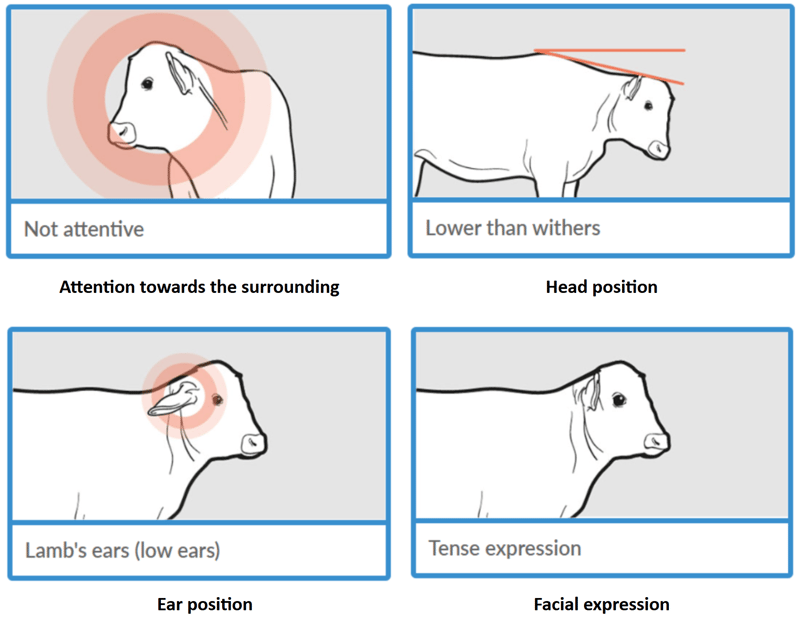
As in cows, pain in calves is generally observed, sought, and acknowledged in only a few well-identified situations. In calves, pain is mainly associated with procedures such as castration, disbudding, and dehorning, or with evident conditions such as lameness, fractures, and osteoarthritis. But what about other, less obvious conditions?
Current reality: awareness among stakeholders is increasing, yet important gaps remain. Even in 2025, farmers and veterinarians report that they require improved training to better recognize pain in cattle.
Improved recognition of pain in calves relies on better knowledge of behavioral signs and, when available, on the collection of additional clues provided by connected devices assessing calf activity and feeding behavior.
Which conditions cause pain signs in calves?
The most painful conditions in calves are not limited to procedures and obvious injuries. Many common diseases, especially diarrhea, respiratory disease, and inflammatory conditions, also involve significant pain that is frequently under-recognized. The most painful conditions are often the most common ones!
Neonatal diarrhea, which is prone to occur in the very first days of a calf’s life, is associated with moderate to acute pain in calves. As in humans, visceral pain, colic, and abdominal cramping cause significant suffering in calves.
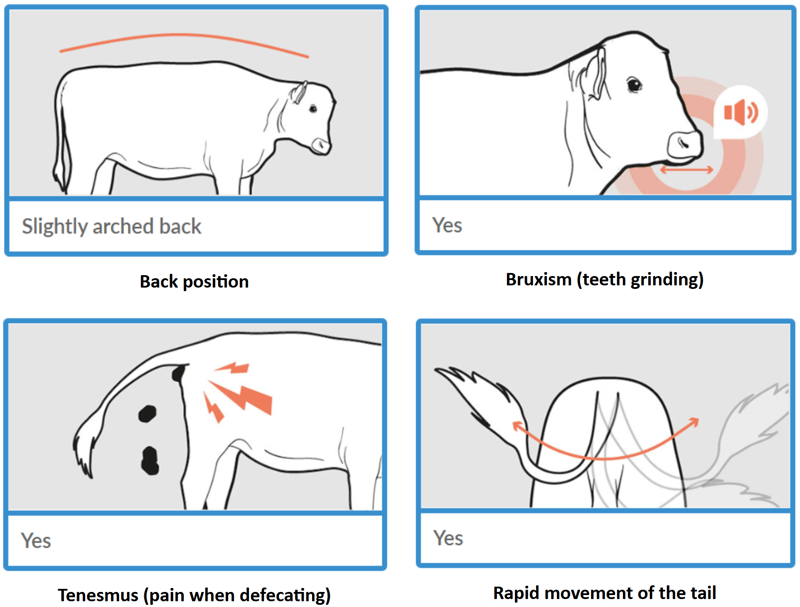
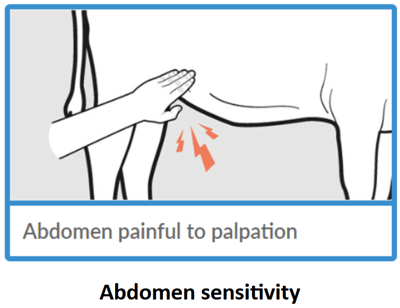
However, farmers and veterinarians mainly focus on controlling the infection, restoring hydration, and preventing fluid losses. This highlights the need to better integrate pain recognition and pain management into treatment protocols for neonatal diarrhea.
Bovine respiratory disease, which is a leading cause of morbidity in calves during the first months of life across production systems, is associated with both non-specific and specific pain-related signs.
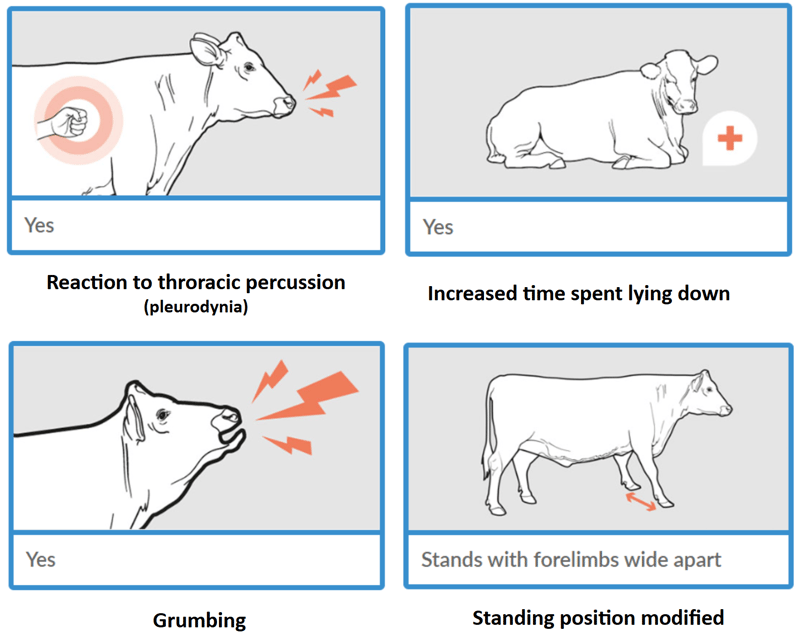
Bovine respiratory disease is associated with inflammatory and pleuritic pain, causing discomfort during breathing.
Veterinarians commonly recognize bovine respiratory disease as a painful condition. In 2021, Theresa Tschoner summarized the existing literature on Median Pain Scores assigned by veterinarians to different procedures and conditions in calves. Across six different surveys, veterinarians attributed a median pain score of 6 out of 10 to pneumonia, although with a wide confidence interval ranging from 1 to 10 (2).
However, clinical management often prioritizes infection and fever, whereas pain is not systematically treated.
Other conditions, including omphalitis, ocular disorders, and abomasal (caillette) ulcers, are also common in calves and are associated with pain.
Finally, a particularly interesting study evaluated the benefits of NSAID treatment in newborn calves, regardless of calving conditions. (3) Behavioural differences between calves treated with ketoprofen and calves treated with saline, in particular increased play, suggest that the birth experience may be painful for all calves, even if no assistance is required. A single dose of ketoprofen in the immediate postpartum period may improve calf welfare regardless of assistance status and has the potential to contribute to significant welfare gains in dairy calves.
How can farmers and veterinarians recognize calf pain signs earlier to make faster decisions and improve outcomes?
Raising awareness among veterinarians and farmers and integrating pain assessment into routine clinical examinations are key steps toward improving pain management in calves. Effective pain mitigation also depends on mindset changes and the availability of practical, easy-to-use tools for pain detection.
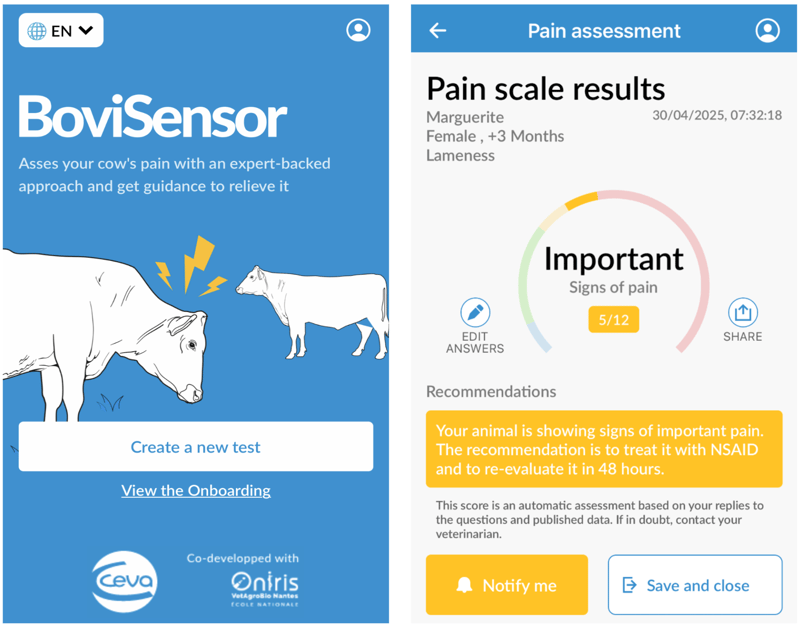
Pain recognition in calves requires knowledge, observation, and practical tools that can be used routinely on farm. BoviSensor, developed under the leadership of Oniris, the National Veterinary School of Nantes, France, with a panel of veterinary experts, provides easy-to-use pain assessment grids adapted to common cattle health conditions.
By guiding veterinarians and farmers through behavior-based criteria and generating a pain score, the app supports more objective pain assessment, facilitates follow-up, and helps bring expert veterinary knowledge into daily calf health management.
BoviSensor is available on the App Store and Google Play to help veterinarians and farmers support objective pain assessment in cattle.
Although veterinarians generally recognize that BRD and neonatal diarrhea are painful conditions, NSAIDs are not systematically prescribed in daily practice, as clinical management often prioritizes pathogen control, fever, and survival.
In calves suffering from neonatal diarrhea, the addition of a single dose of meloxicam to symptomatic and antibiotic treatment resulted in increased starter feed intake (0.15 kg) and water consumption (1.1 L). Calves were 5.3 times more likely to consume their entire milk allowance and gained an additional 4.3 kg of body weight over the 8-week study period compared with calves receiving symptomatic treatment and antibiotics alone (Todd et al., 2010).
When treating bovine respiratory disease (BRD) in sick calves, the administration of NSAIDs in combination with antibiotic therapy accelerates clinical improvement, including cough, nasal discharge, dyspnea, depression, and anorexia, as well as the return to a physiological rectal temperature. Meloxicam also reduces lung lesions. Average daily gain and carcass weight are higher in groups receiving NSAIDs in addition to antibiotic treatment.
The evidence exists and knowledge is increasing, but action does not consistently follow.
In 2023, S. Mijares et al. (4) described US veterinarians’ current detection methods and treatment practices for BRD. All veterinarians indicated that BRD was at least mildly painful. However, only 53% of veterinarians assessed pain in preweaned calves with BRD in order to make treatment decisions.
The evolution of practices will foster closer collaboration between veterinarians and farmers, helping to meet societal expectations, reduce production losses, ensure animal welfare, improve the management of sick animals, strengthen the farmer–animal relationship, and optimize herd performance.
Take home messages
Disease drives pain → pain impacts welfare → reduced welfare affects performance.
Encouraging the systematic recognition of pain signs in calves is essential to enable faster and more informed decision-making.
Early identification supports prompt intervention, limiting disease progression and reducing suffering, while ultimately preserving animal welfare, health status, and productive performance.

References
1 Molony V, Kent JE: Assessment of Acute Pain in Farm Animals Using Behavioral and Physiological Measurements. J. Anim. Sci. 75:266-272, 1997.
2 Tschoner, T. Methods for Pain Assessment in Calves and Their Use for the Evaluation of Pain during Different Procedures—A Review. Animals 2021, 11, 1235
3 Gladden N. and all: A single dose of ketoprofen in the immediate postpartum period has the potential to improve dairy calf welfare in the first 48 h of life. Applied Animal Behaviour Science 212, 19-29, 2019.
4 Todd CG, Millman ST, McKnight DR, Duffield TF, Leslie KE. Nonsteroidal anti-inflammatory drug therapy for neonatal calf diarrhea complex: Effects on calf performance. J Anim Sci. 2010 Jun;88(6):2019-28.
5 Friton GM, Cajal C, Ramirez-Romero R. Long-term effects of meloxicam in the treatment of respiratory disease in fattening cattle. Vet Rec. 2005 Jun 18;156(25):809-11.
6 Mijares S, Edwards-Callaway L, Roman Muniz IN, Coetzee JF, Applegate TJ and Cramer MC (2023) Veterinarians’ perspectives of pain, treatment, and diagnostics for bovine respiratory disease in preweaned dairy calves. Front. Pain Res. 4:1076100.

Leave your comments here