


A young calf’s life is anything but easy.
Born with no maternal antibodies, newborn calves depend entirely on colostrum for passive immunity to protect them from the main pathogens they are exposed to.
A failure of adequate transfer of passive immunity puts the calf at risk of developing numerous neonatal diseases, including neonatal diarrhea and bovine respiratory disease.
In addition, the growth and future productivity of affected calves may also be compromised.
For all these reasons, ensuring high‑quality calf care is essential to preserving the overall health and long‑term productivity of the herd.
Prefer to listen to this article? Click the play button below and enjoy our podcast!
What is the very first calf care challenge during the first 24 h?
There is a direct link between the efficiency of colostrum absorption and the calf’s subsequent health, growth, and overall resilience(1).
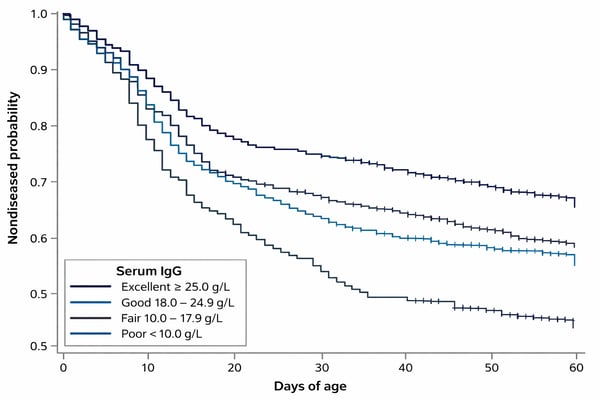
Recent recommendations indicate that a minimum serum IgG concentration of 25 g/L is required to classify passive transfer as adequate in newborn calves (1,2). To reach this level, given that calves absorb on average 30% of the IgG they ingest during the first hours of life(3), a newborn calf must consume approximately 200 to 300 grams of immunoglobulin G (IgG) within the first 24 hours of life.
This means that a calf needs, for example, to consume 3 to 4,5 L of a good colostrum at 70 IgG/L.
This implies a quick intake of a sufficient quantity of clean, highquality colostrum, while quantifying the outcome to ensure that colostrum administration has been successful.
Despite significant efforts, 5,8 to 34,5% of beef calves(4) and 4,8 to 64,5 % of dairy and veal calves(5) still fail to achieve adequate transfer of passive immunity.
Numerous risk factors have been identified so far, including calf sex, twin status, calf vigor, birth weight, month of birth, dam body condition score and udder conformation, breed, parity, genetics, prepartum vaccination and nutrition, length of the dry period, the amount of colostrum produced, calving area and calving difficulty, as well as a condensed calving pattern.
Failure of transfer of passive immunity remains one of the major contributors to morbidity and mortality in young calves, significantly increasing their susceptibility to enteric and respiratory diseases.
What infectious challenges do calves face right after the first day of life?
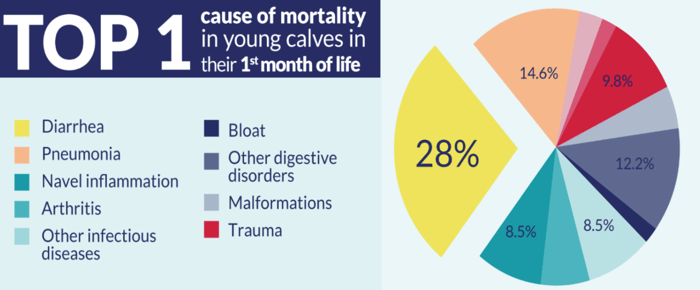
Neonatal diarrhea is the earliest and most common infection in calves after day 1. It is also the first cause of mortality in the first month of age(6).
The probability of disease is highest between 10 and 15 days of age, but remains quite elevated until around 40 days of age(7).
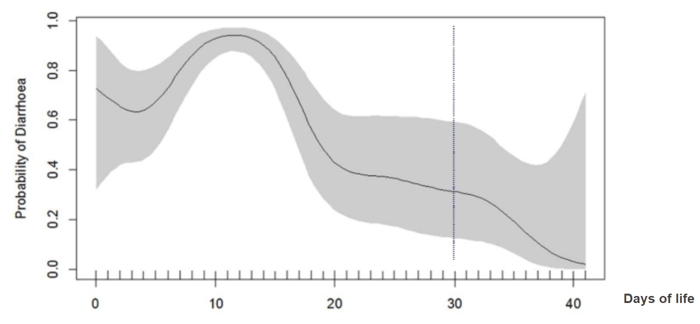 Key pathogens include a wide range of viruses, bacteria, and parasites, each capable of causing disease on their own or in combination with others. Ubiquitous in the neonatal environment and frequently shed by older, asymptomatic animals, these pathogens often colonize the newborn’s intestine within the first days of life.
Besides these pathogens, unhygienic rearing systems, high stocking density, overcrowding in the calving pen, and failure of adequate transfer of passive immunity are major predisposing factors.
Between 20% and 40% of calves are still affected by neonatal diarrhea(8).
Enterotoxigenic E. coli (ETEC, F5/K99) affects calves mainly during the first 4 days of life; one of the most prevalent early-life pathogens.
Rotavirus & Coronavirus are the major viral causes of neonatal diarrhea during the first week of life.
Cryptosporidium parvum infections peak between 1 and 3 weeks of age.
Performing diagnostic analyses is crucial to differentiate between these infections, as co‑infections are frequent (9,10) and clinical signs are rarely specific. This allows treatment to be adapted in a timely and appropriate manner.
If preventive measures, including dam vaccination and adequate colostrum intake, have not been implemented or have been insufficient, symptomatic and etiological treatments become necessary to minimize the risk of long‑term complications. Hygienic measures—such as cleaning calving pens between each cow, separating the maternity area from calf housing, and disinfecting individual calf pens—contribute significantly to the success of both preventive and curative strategies. In addition, several of these pathogens have zoonotic potential.
Once calves are 3 weeks old, what can happen to them?
After the neonatal period—when Cryptosporidium parvum is the dominant parasite—calves begin to face another group of enteric parasites. These three become particularly relevant from 3 weeks of age onward, and their impact is amplified in winter‑born calves raised in moist, poorly ventilated, or overcrowded environments.
Eimeria spp. (Coccidia) is a major cause of diarrhea from 3 weeks to several months of age. Infection thrives in moist, humid bedding, which allows oocysts to sporulate and become infective.
Strongyloides is a nematode affecting ruminants, with a significant impact under unhygienic indoor conditions. Humidity trapped in bedding (especially sawdust or straw) provides ideal conditions for rapid development of infective larvae.
Giardia duodenalis also can appear after 3–4 weeks of age.
These three parasites(11) can cause chronic digestive problems and poor weight gain, especially during winter when calves have limited access to dry, clean environments. Affected groups often show a dull hair coat, slowed growth, and feces that range from soft to clearly diarrheic.
Diagnosis is performed through coproscopic examination, and treatment relies on the use of parasiticides and on strengthening the calves’ immune defenses, while improving their living conditions as much as possible.
What are key health risks before weaning?
In calf rearing, the period just before weaning (typically the last 2–4 weeks) still carries several important health and management risks.
Grouping, stress, fluctuating temperatures, or poor ventilation make calves more vulnerable and can trigger Bovine Respiratory Disease, caused by viruses (Bovine Respiratory Syncytial Virus, Parainfluenza 3 virus, coronavirus) and bacteria (Mannheimia haemolytica, Pasteurella multocida, Histophilus somni, Mycoplasma bovis).
Cold, damp weather, and high stocking densities increase stress and facilitate the spread of respiratory pathogens in the herds.
Bovine Respiratory Disease (BRD) is present in calves worldwide. Its prevalence varies widely according to region, season, and production system, ranging from 2% to 20% at the calf level(12). Accurate prevalence estimates are challenged by the high proportion of subclinical cases. Lung ultrasonography allows early and reliable detection of BRD lesions. In addition, PCR analyses performed on nasal swabs, transtracheal aspirates, or bronchoalveolar lavage samples enable etiological diagnosis and facilitate the implementation of targeted, pathogen‑specific treatments. Improvement of housing conditions, nutritional management, and vaccination protocols adapted to the circulating pathogens should be implemented to prevent these diseases.
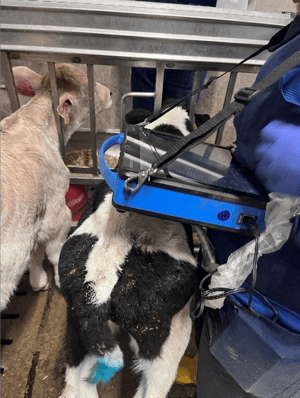
Before weaning, attention should be focused on:
- Ensuring sufficient solid feed intake to support rumen development and prevent a post‑weaning growth check.
- Implementing an appropriate parasite control program, adapted to the farm’s risk factors.
- Maintaining stable grouping and environmental conditions to reduce stress and disease susceptibility.
- Providing good ventilation and clean bedding to limit pathogen load and support respiratory health.
- Monitoring for early clinical signs, such as cough, nasal discharge, or reduced growth, to enable prompt intervention.
Take Home Message
- Focusing on colostrum intake is essential for giving calves a healthy start in life.
- Biosecurity, prevention, and surveillance can help reduce the occurrence of neonatal diseases.
- Early treatment with targeted, specific solutions should enable calves to recover fully without long-term consequences.
References
- Godden S.M., Lombard J.E, Woolums A.R.: Colostrum Management for Dairy Calves. Vet Clin North Am Food Anim Pract 2019 Nov;35(3):535-556.
- Lombard J. et al: Consensus recommendations on calf- and herd-level passive immunity in dairy calves in the United States. J Dairy Sci 2020 Aug;103(8):7611-7624.
- Halleran J. et al: Short communication: Apparent efficiency of colostral immunoglobulin G absorption in Holstein heifers. J. Dairy Sci. 2017, 100:3282–3286.
- Abdelfattah, E.; Fausak, E.; Maier, G.: Failure of Passive Immune Transfer in Neonatal Beef Calves: A Scoping Review. Animals 2025, 15, 2072.
- Male Here R.R. et al: Factors associated with failure of passive transfer of immunity and morbidity in spring-born beef and dairy calves during the first 30 days of life. Front. Vet. Sci. 2026 Sec. Veterinary Epidemiology and Economics Volume 12.
- Svensson C. et al: Mortality in Swedish Dairy Calves and Replacement Heifers J. Dairy Sci. 2006, 89:4769–4777.
- Thomson S.: Shedding of Cryptosporidium in calves and dams: evidence of re-infection and shedding of different gp60 subtypes. Parasitology , 2019 , Vol 146 (11) , 1404-1413.
- Mee J;F.: Invited review: Bovine neonatal morbidity and mortality—Causes, risk factors, incidences, sequelae and prevention. Reproduction in Domestic Animals, Volume 58: 1st European Symposium on Animal Reproduction, 21st – 23rd September 2023, Nantes, France.
- Brunauer, M.; Roch, F.-F.;Conrady, B.: Prevalence of Worldwide Neonatal Calf Diarrhoea Caused by Bovine Rotavirus in Combination with Bovine Coronavirus, Escherichia coli K99 and Cryptosporidium spp.: A Meta-Analysis. Animals 2021, 11, 1014.
- Yong-il Cho, Kyoung-Jin Yoon: An overview of calf diarrhea - infectious etiology, diagnosis, and intervention. J. Vet. Sci. (2014), 15(1), 1-17.
- Jäger M. et al: Endoparasites in calves of beef cattle herds: Management systems dependent and genetic influences. Veterinary Parasitology Volume 131, Issues 3–4, 10 August 2005, Pages 173-191.
- O’Donoghue S. et al: A Comprehensive Review: Bovine Respiratory Disease, Current Insights into Epidemiology, Diagnostic Challenges, and Vaccination. Vet. Sci. 2025, 12, 778.

Leave your comments here